Plink by Pokerist
- 4.2
- Rating
- 1.00M
- Installs
- Free
- Price
 Analysis by App-foxy
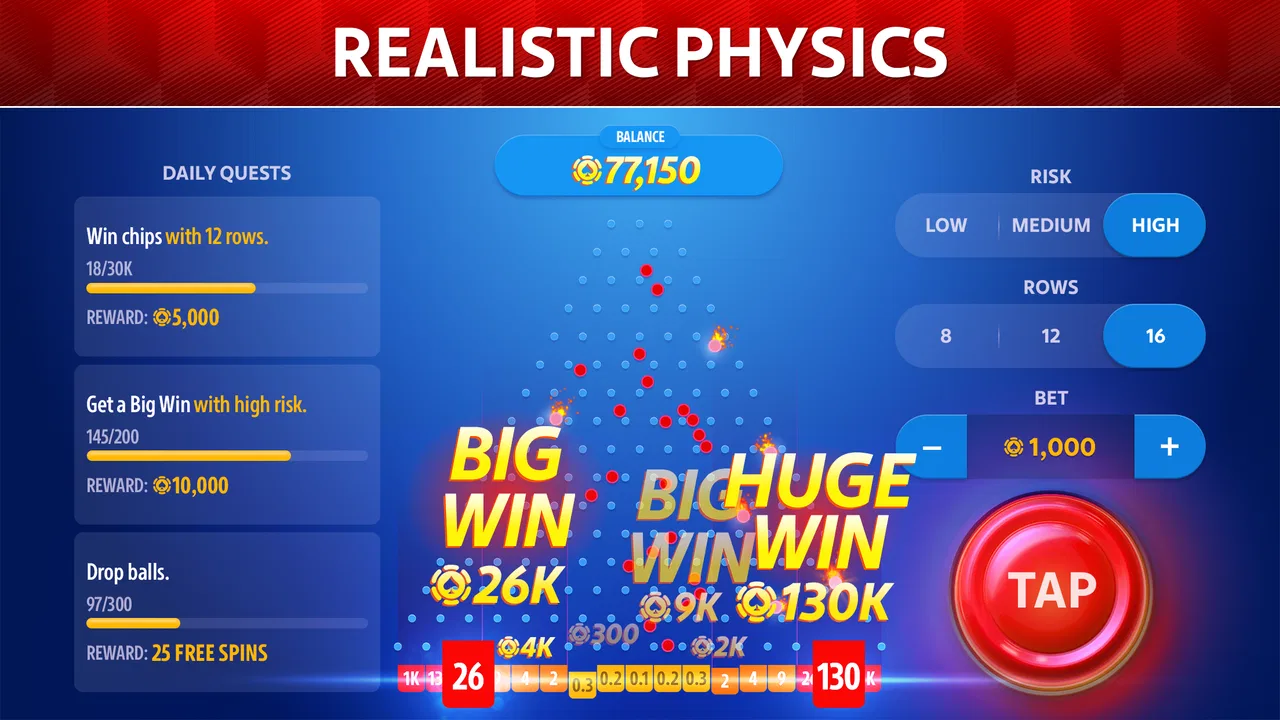
I spent time with Plink by Pokerist as a quick arcade game built around timing, rebounds, and multiplayer play. Its appeal is easy to understand: you make a move, watch the puck or ball travel through a field of pegs, and hope your reading of the physics produces a rewarding result. It looks simple at first, but the interesting part is learning how much control you really have over an outcome that also depends on ricochets.
That combination makes it a very different experience from a traditional reflex arcade game. You are not simply trying to tap faster than an opponent. You are watching angles, choosing when to commit, and judging whether a promising route is worth the risk. I found it most enjoyable in short sessions, especially when I wanted something more interactive than a solo time-killer but less demanding than a full strategy game.
How the first sessions establish the game’s goals
The early goal is straightforward: understand the board, make better launches, and turn each attempt into a more favorable result. The game does not need a complicated opening tutorial to communicate that idea. The physical path is visible, so every bounce gives immediate feedback. When a launch goes wide, clips an unexpected peg, or falls into a less useful area, I can usually connect the result to my decision rather than feeling completely lost.
You May Also Like

 Blood Strike: 2.5 Anniversary
Blood Strike’s Loadouts Turn Every Drop Into a Tactical Gamble
A close look at Blood Strike’s custom loadouts: how fast access to signature weapons reshapes its battle royale rhythm, rewards preparation, and narrows the gap between fights.

 Pandora - Music & Podcasts
Pandora’s Music Is Easy to Start, but Harder to Recover
Pandora’s strength is its low-effort path from a seed to a station. Its weak spot is how much confidence it asks you to place in connection, setup, and quiet recovery.

 8 Ball Pool
 Is Built on Rivalries, Rematches, and Routine
A close look at the rivalries, rematches, shared routines, and unanswered safety questions that turn a quick pool match into a persistent mobile community.

 Samsung Music
’s Quiet Strength Is Playing What You Already Own
Its reach comes less from spectacle than from dependable access to a personal library. That simplicity is both the app’s strongest retention engine and its ceiling.

 AccuWeather: Weather Radar
AccuWeather Review: A Quick, Clear Forecast for Everyday Decisions
For everyday plans, the best forecast is the one you can understand quickly. AccuWeather makes rain timing, radar, and local conditions easy to act on, with a few trade-offs.

 Hill Climb Racing
Why Hill Climb Racing Still Turns Crashes Into One More Run
A tiny car, a bumpy hill and one more upgrade: Hill Climb Racing keeps resurfacing because its simple chaos makes every near-miss feel personal.
More From Our News Desk



That clarity matters because arcade games often lose players by throwing too many systems at them before the basic action feels satisfying. Plink keeps the central interaction readable. I can focus on the trajectory, the available openings, and the likely chain of rebounds instead of learning a large collection of unrelated controls. For a newcomer, that makes the first few rounds approachable even if the later decisions become less obvious.
The multiplayer framing also changes the meaning of those early goals. In a purely solo Plinko-style game, a good drop is mainly a personal score. Here, the result has a competitive context. Even when the round is short, I am not only asking whether my move looked good; I am asking whether it gave me a better position than the other player. That small shift makes ordinary launches feel more purposeful.
I would recommend beginning with patience rather than trying to force spectacular outcomes. My first instinct was to aim for the most attractive-looking route, but the board can punish an overly ambitious line with several unpredictable-looking deflections. A safer launch that keeps more possibilities open can be more useful than one that appears to target the biggest reward immediately. That is one of the first practical lessons the physics communicates.
What makes the physics worth learning
The realistic physics are not just decoration. They create the game’s main learning loop. A launch can look correct at the starting point and still change dramatically after the first few contacts. I began paying attention to the angle of entry rather than only the destination I wanted. That helped me make more informed choices, even though it never removed the uncertainty that gives the game its identity.
This is also where the game separates itself from a simple random drop simulator. The player’s input still matters before the chain of rebounds begins. The skill is not complete control; it is making the best initial decision while accepting that the board will introduce variation. Players who enjoy reading physical interactions should find more depth here than the short description suggests.
A useful everyday scenario is a short break when I have only a few minutes and do not want to commit to a long campaign. I can play a handful of rounds, notice one mistake in my launch angle, and stop without losing the thread of a story or a large mission. If a friend is available for multiplayer, the same spare moment becomes more engaging because the result has an immediate comparison.
Progress signals and the feeling of getting better
Plink’s strongest progress signal is not a traditional character journey. It is the gradual improvement in how I read the board. Early on, a bounce can feel like a surprise. After more play, I start recognizing which starting positions create safer lines and which choices depend too heavily on a fortunate deflection. That personal improvement is subtle, but it is more meaningful than simply watching a number rise.
The game’s arcade structure benefits from this kind of compact feedback. A round ends quickly, so I can remember what I attempted and immediately test a different approach. That makes experimentation practical. I do not have to wait through a long level to find out whether a change in angle helped. The next opportunity arrives soon, which keeps the learning loop active.
For me, the best progress signal is a better decision before the result appears. A lucky outcome is enjoyable, but it does not necessarily prove that I played well. When I choose a route because it gives me a sensible chance rather than because it looks dramatic, I feel that I am developing a real understanding of the game. That distinction is important for anyone who prefers skill-based satisfaction over pure reward chasing.
The multiplayer setting adds another layer to this progress. Facing another person, rather than only repeating a personal attempt, exposes habits that can remain hidden in solo play. I may discover that I always favor the same side of the board or overvalue a high-looking target. A competitive round makes those tendencies visible because the other player’s outcome gives me a reference point.
How to use short sessions intelligently
I found it helpful to treat each small session as a test of one idea. Instead of changing everything after a poor result, I would adjust one part of my approach: the starting angle, the amount of risk, or the timing of a decision. This keeps the physics readable. If I make several changes at once, a good result teaches me very little about why it happened.
Another useful habit is to separate a visually exciting result from a repeatable tactic. A spectacular chain of rebounds can be memorable, but it may depend on circumstances I cannot reproduce. The more valuable question is whether I can make a similar opening decision again. That mindset prevents the game from becoming a search for lucky moments only.
Because the game is free, it is easy to try this learning process without an upfront purchase. It is available on Android devices running version 6.0 or later, which makes the entry point broad for players using older compatible hardware. The current version is 75.8.0, so anyone installing it should still check that their device handles the live multiplayer experience comfortably.
Difficulty, pacing, and where the challenge comes from
The difficulty does not come from a complicated control scheme. It comes from limited certainty. I can make a thoughtful launch, but I cannot dictate every rebound. That creates a gentle tension: the game rewards preparation without promising complete control. Players who want a perfectly predictable puzzle may find that frustrating, while players who enjoy managing risk should appreciate the balance.
The pacing is naturally brisk because the central action resolves quickly. This helps the game avoid a common arcade problem in which failure feels expensive in time. A poor attempt is disappointing, but it does not usually require a long recovery. I can try again, adjust my reading, and retain the emotional momentum of the previous round.
At the same time, quick rounds can make the experience feel repetitive if I am not interested in refining my decisions. The board interaction is the attraction, so players looking for a large narrative, extensive exploration, or a broad collection of activities should choose a different kind of game. Plink is focused. Its strength is also its boundary.
The challenge curve feels less like a sequence of dramatic level gates and more like a gradual increase in personal expectations. Once I understand the basic motion, I stop being satisfied by merely completing a drop. I want a cleaner line, a better risk assessment, and a stronger multiplayer result. That self-imposed standard can sustain play, but it depends on whether the player enjoys mastery for its own sake.
Where randomness helps and where it can irritate
The physics create memorable reversals, which is valuable in a competitive arcade game. A move that looks ordinary can become favorable after a series of rebounds, while an apparently excellent opening can lose its advantage. Those reversals keep matches from feeling completely decided at the start.
However, the same uncertainty can feel unfair when I believe I made the better initial choice but the later contacts erase that advantage. My advice is to approach each round as a probability decision rather than a guaranteed solution. If I expect total control, the game can feel inconsistent. If I accept that the goal is to improve the odds, the results are easier to enjoy.
This is a meaningful trade-off compared with more conventional arcade alternatives. A pure reflex game usually makes the connection between input and outcome more direct, while a puzzle game often offers a fixed solution. Plink sits between those models: the opening decision is intentional, the physical resolution is variable, and the satisfaction comes from finding better judgment within that uncertainty.
Retention pressure, purchases, and multiplayer motivation
The game’s retention strength comes from the desire to try one more round after a near miss. Because the action is compact, that extra attempt feels easy to justify. I can also understand why a multiplayer result encourages return visits: a close loss or a surprisingly strong win creates a specific reason to play again rather than a vague promise of progress.
That loop is effective when I am actively learning. It is less convincing when I am playing mechanically without noticing anything new. The game needs the player to remain curious about the physics and competitive outcomes. If that curiosity fades, short sessions can start to blur together.
There is a practical financial consideration. The game is free to download, but it includes optional in-app purchases ranging from $0.99 to $999.99 per item. That is a very wide range, and it is the main point where I would advise caution. I would decide in advance whether I am comfortable spending anything, keep purchases separate from the enjoyment of the core rounds, and avoid treating a disappointing result as a reason to buy an advantage or continue spending.
For families, the Teen content rating is worth taking seriously. Even if the basic action looks approachable, the multiplayer and purchase context make it better suited to users who can manage competitive play and spending decisions responsibly. I would not hand the device to a younger child without checking the store controls and payment protections first.
The multiplayer focus also means the quality of a session depends partly on the people involved. Playing against others can make the game feel lively and unpredictable, but someone seeking a completely private, offline-style experience may prefer a solo arcade title. Plink is at its best when competition adds energy rather than pressure.
Who should install it, and who should skip it
I would recommend it to players who like physics-based arcade games, short competitive rounds, and the process of turning uncertain outcomes into better decisions. It is especially suitable for someone who enjoys games that are easy to understand but leave room for judgment. The realistic motion gives each attempt enough personality to make repetition worthwhile.
I would be more cautious recommending it to anyone who dislikes chance influencing a competitive result. If you need every loss to be clearly traceable to a mistake, the rebounds may test your patience. I would also point players toward a traditional puzzle game if their priority is fixed logic, or toward a reflex arcade game if they want direct reactions to matter more than trajectory planning.
The developer, KamaGames, has positioned this as a recognizable real-life Plink-style experience with multiplayer at its center. In practice, that means the game is not trying to replace a large arcade collection. It is offering one focused activity and asking whether its physics and competition are enough to keep you returning.
My progression verdict after settling into the rhythm
Plink succeeds when its progression is understood as improved judgment rather than a parade of invented milestones. The early goals are clear, the feedback arrives quickly, and the difficulty grows through a deeper reading of angles and risk. I felt the strongest sense of advancement when I could explain why a launch was sensible even before seeing where the rebounds carried it.
Its pacing is another clear strength. Short attempts make experimentation painless, and multiplayer gives ordinary decisions a reason to matter. The experience does not require a large time commitment, which makes it easy to fit into a commute, a waiting room, or a brief evening break. That convenience is valuable, though it cannot compensate for a lack of interest in the core physics.
The main limitations are equally clear. Unpredictable rebounds can undermine a player who expects complete control, repeated rounds may lose their appeal without a personal mastery goal, and the broad range of optional purchase prices calls for careful spending boundaries. Those are not minor details; they determine whether the game feels like a relaxed arcade diversion or an overly persistent competitive loop.
With a 4.2 average from around 17 thousand ratings and more than a million installs, it has already found a substantial audience. I can see why: the basic idea is familiar, the controls are approachable, and the multiplayer setting gives the physics a social purpose. Still, popularity does not remove the need to match the game to your preferences.
My final recommendation is simple: try it if you want a free arcade game where the goal is to make smarter launches, not memorize a long progression system. Give it a fair test over several short sessions, pay attention to repeatable choices rather than lucky rebounds, and decide whether the competitive uncertainty feels exciting or irritating. If that uncertainty becomes part of the fun, Plink has enough personality to earn a regular place in your quick-play rotation.
FAQs for Plink by Pokerist
01What is Plink by Pokerist?
Plink by Pokerist is a social gaming app centered on casual card and casino-style entertainment, allowing players to enjoy poker-inspired gameplay and interact with other users. It is designed for quick sessions rather than serious competitive poker training. The app may include virtual chips, rewards, events, and social features, so the exact experience can vary depending on the current version and available region.
02Is Plink by Pokerist free to download and play?
Plink by Pokerist can generally be downloaded for free on supported Android and iOS devices, with optional in-app purchases. Players can usually begin with complimentary virtual resources, but some features, bonuses, or additional chips may encourage purchases. Because virtual items do not normally have cash value, users should review the store description, spending controls, and purchase settings before allowing children or other users to access the app.
03Does Plink by Pokerist require an internet connection?
An internet connection is typically important for Plink by Pokerist because the app relies on online services for account access, player interaction, events, synchronization, and updates. Some screens or limited activities may load without a stable connection, but the main experience may not work properly offline. Wi-Fi or a reliable mobile data connection is recommended, especially when participating in multiplayer or time-limited activities.
04Can I play Plink by Pokerist with other people?
Yes, the social aspect is one of the main reasons to try Plink by Pokerist. Depending on the current release, players may be able to compete or interact with other users through online tables, challenges, rankings, clubs, or chat-related features. Matchmaking and available social tools can differ by platform, location, and app version. Users who prefer a quieter experience should check the privacy and notification settings.
05Is Plink by Pokerist suitable for children?
Parents should review the age rating and content information shown on the Google Play Store or Apple App Store before installing Plink by Pokerist. Although the app uses virtual currency rather than necessarily offering real-money gambling, casino-style mechanics, social interaction, advertisements, and optional purchases may not be appropriate for every child. Enabling parental controls and purchase restrictions is advisable, particularly on shared devices.
Pros
- Quick
- casual poker rounds suited to short play sessions.
- Simple interface makes the game easy for newcomers to navigate.
- Offers social interaction through tables
- chat
- and multiplayer play.
- Playable on mobile devices without requiring advanced poker knowledge.
- Regular events and challenges can add variety to standard matches.
Cons
- Progress can feel slow without spending chips or using bonuses.
- Virtual currency systems may encourage frequent in-app purchases.
- Random matchmaking can create uneven games between different skill levels.
- Chat features may expose players to spam or unpleasant interactions.
- An internet connection is generally required for the full experience.

Plink by Pokerist
Gallery